UFLI 对齐阅读理解题库(Texts 16–128)深度解析:K-6 分层测评与“即印即用”课堂方案
A practical deep review of a UFLI-aligned reading comprehension set for Texts 16–128: 3 print-and-go pages per text with MCQ, true/false, open response, writing, and word work for K–6.
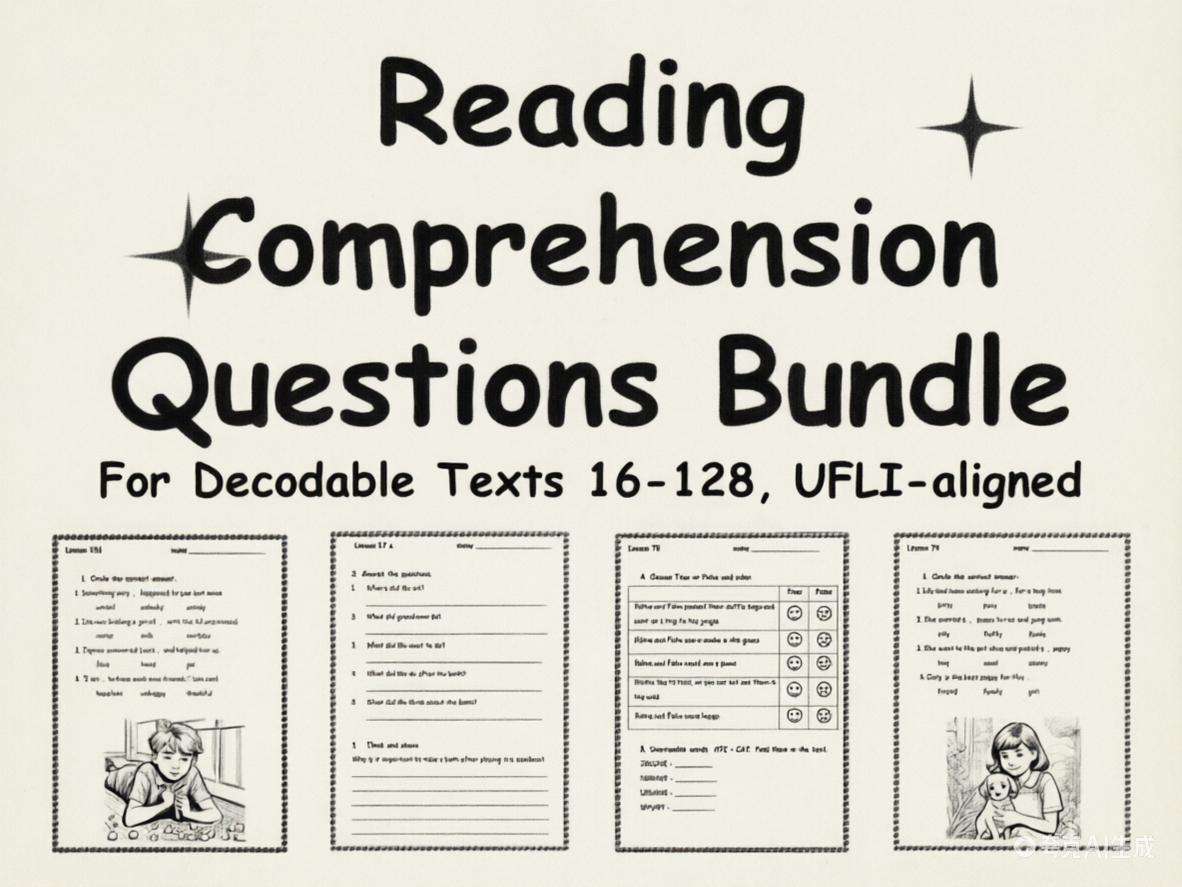
如果你正在寻找一套“真正能落地”的阅读理解配套练习,既能对齐系统的自然拼读进度,又能用来做小组教学、个别化辅导或形成性评估,那么这套 UFLI aligned 的阅读理解问题与测评资源(覆盖 Texts 16–128)会非常适合。它主打“NO PREP、PRINT & GO(免备课、打印即用)”,并以科学阅读(Science of Reading)的思路,把理解训练融入每一次短文阅读之后,让学生在练习中建立可迁移的理解策略。
下面我会从内容结构、适用年级、题型价值、课堂使用流程、差异化与评估方法等维度做一次“深度阅读式”的拆解,帮助你判断是否值得纳入你的阅读教学体系。
关键词(中文):UFLI 阅读理解,UFLI aligned,科学阅读 SoR,自然拼读配套阅读理解,小学阅读理解测评,打印即用阅读练习,K-6 阅读理解题库
Keywords (English): UFLI aligned reading comprehension, Science of Reading comprehension, phonics-aligned passages, print and go reading assessment, differentiated comprehension worksheets, small group reading comprehension
一、这套资源到底是什么?(适合谁、解决什么问题)
这是一套为 Texts 16–128 配套设计的阅读理解练习与评估材料,核心目标很明确:
在学生完成对应短文阅读后,用结构化题目引导学生“读懂、说清、写出”,并可作为日常检查理解的工具。
它尤其适合以下场景:
•
你已经按明确的自然拼读/技能序列推进阅读材料,希望理解练习与之同步
•
你需要高频、稳定、可复用的理解题,用于小组轮转(small group)、干预(intervention)或课后巩固
•
你希望把“理解测评”做得更轻量:不额外设计题目、不额外找材料
二、内容结构:每个文本 3 页,形成“阅读—理解—拓展”的闭环
资源的组织方式非常清晰:
•
每个文本配套 3 页活动(Texts 16–128)
•
题目与活动类型覆盖多种理解层级与输出方式
每个文本的活动包含(按公开说明整理):
•
Multiple Choice Questions(选择题)
•
Open Ended Questions(开放问答/简答)
•
True or False Questions(判断题)
•
Creative writing idea(创意写作延伸)
•
Unscramble words and find them in the text(单词重组 + 文中定位)
•
Picture to color(配图涂色/视觉参与)
这种组合的价值在于:
•
选择/判断题适合快速检查“抓到信息了吗”
•
开放题推动学生用语言组织理解(更接近真实阅读能力)
•
写作延伸把理解迁移到表达,利于高阶思维
•
单词重组 + 文中定位将“解码/词汇注意”与理解联系起来
•
图片涂色增强低年级参与度与完成感(也降低任务焦虑)

三、题型为什么有效:把“理解”变成可观察、可评估的行为
很多阅读理解练习的问题是:题目形式单一,学生要么靠猜,要么只是“圈原句”。而这套题型组合更接近课堂真实需求——你可以从学生的作答中观察到不同层次的理解表现:
•
事实性理解(literal comprehension):能否找对细节、人物、地点、事件顺序
•
推断性理解(inferential):能否根据文本线索做合理推断(开放题更能体现)
•
表达与迁移(retell/response):能否用自己的话回答、扩写、改写
对于“高水平思考者”(high-level thinkers)来说,开放题与写作延伸也提供了更大的上限;对于需要支持的学生,选择题与判断题则提供了更低的进入门槛。

四、课堂怎么用最顺:4 种“打印即用”流程模板
你可以把每个文本的 3 页当作一个“小模块”,按你的课堂节奏自由拆分。以下是几种常见、最省心的用法:
1)全班共读 + 独立作答(最常用)
•
教师带读/齐读短文
•
学生独立完成选择题、判断题
•
选 1–2 道开放题全班口头分享或写作
适合:一年级到三年级的常规阅读课
2)小组阅读站(Literacy centers / rotation)
•
A 组:教师指导阅读 + 开放题
•
B 组:独立完成选择/判断
•
C 组:词汇活动(重组 + 文中定位)
适合:需要差异化、站点轮转的班级
3)干预/补救(Intervention / RTI)
•
只用选择题 + 判断题做快速检查
•
开放题改为口头回答(降低书写负担)
•
用错误类型标记学生卡点(细节、词汇、推断)
适合:学习困难、注意力挑战或需要更高频反馈的学生
4)形成性评估(Formative assessment)
•
固定每周选 1–2 个文本
•
记录学生在不同题型中的得分与表现
•
用数据决定下周的复习重点
适合:需要“轻量但持续”的评估体系

五、差异化教学怎么做:同一篇文本,做到“不同难度的同目标”
这套资源的一个隐性优势是:题型本身就支持差异化。
•
对基础学生:优先完成判断题与选择题;开放题可提供句型支架(sentence stems)
•
对中等学生:选择/判断 + 1–2 道开放题完整书面回答
•
对高水平学生:加入创意写作延伸(改变结局、增加细节、换视角复述等)
你甚至可以用同一份材料做“同文本不同任务”,避免分层教学时反复找不同资源导致的管理成本。

六、为什么说它对齐科学阅读(Science of Reading)
科学阅读强调:解码(decoding)与语言理解(language comprehension)共同决定阅读理解。很多课堂要么只练自然拼读,要么只做理解题,二者脱节。
这套材料的设计更像“桥梁”:
•
文本阅读后立即进入理解任务,减少“读完就结束”的空档
•
通过词汇活动把注意力拉回到文本语言本身
•
多题型输出让学生不仅“读懂”,还要“说出来/写出来”
对于已经按范围与序列推进技能的课堂来说,这种配套材料能显著降低教师备课负担,同时保持理解训练的系统性。

七、资源概览(快速决策点)
如果你正在权衡是否要引入它,可以用下面这些“是否命中需求”来快速判断:
•
你需要覆盖大量文本(16–128),且希望每篇都有稳定的理解练习
•
你偏好免备课、打印即用的形式
•
你希望题型多样:选择、判断、开放、写作、词汇活动、简单图像参与
•
你希望材料可用于小组、个别化辅导和形成性评估
只要以上命中 2–3 条,通常就能带来很高的使用频率。
English Version
Deep Review: UFLI-Aligned Reading Comprehension Questions (Texts 16–128) for K–6 Assessment & Differentiation
Looking for a truly “print-and-go” reading comprehension companion that aligns with a structured phonics scope and sequence and supports small groups, intervention, and quick assessments? This UFLI-aligned reading comprehension resource for Texts 16–128 is designed to help teachers build comprehension routines without extra prep—while still offering variety, rigor, and differentiation.
Below is a practical, classroom-focused breakdown of what’s included, why the task design works, and how to use it efficiently across K–6 settings.
Keywords: UFLI aligned reading comprehension, phonics aligned comprehension questions, Science of Reading comprehension worksheets, print and go reading assessment, differentiated comprehension activities, small group reading comprehension
What It Is (and Who It’s For)
This resource provides structured comprehension activities for a large set of texts (16–128). The goal is simple: after reading a passage, students respond to targeted questions and tasks that make comprehension visible—fast enough for daily instruction, and consistent enough to track growth.
It’s especially useful if you:
•
follow a clear phonics progression and want comprehension practice to match
•
need reliable comprehension checks for small groups or intervention
•
want low-prep materials that still support higher-level thinking

What’s Included: 3 Pages per Text (16–128)
Each text includes three pages of activities, creating a repeatable routine that supports both practice and assessment. The activity types include:
•
Multiple choice questions
•
Open-ended questions
•
True/false questions
•
A creative writing extension
•
Word work (unscramble words + locate them in the text)
•
A picture-to-color component (engagement + accessibility)
This mix matters because it lets you assess different comprehension demands—quick accuracy (MC/TF), expressive understanding (open response), and application/transfer (writing).

Why the Question Types Work (Assessment + Instruction)
A strong comprehension tool should do more than “check answers.” It should help you observe how students understand text.
•
Multiple choice & true/false: efficient for quick checks and routine building
•
Open-ended response: reveals reasoning, inference, and language production
•
Creative writing: pushes transfer and deeper thinking
•
Word work + text evidence: keeps students anchored to the passage language
The result is a flexible set of tasks you can scale up for strong readers or scaffold down for students who need support.

4 Print-and-Go Ways to Use It in Class
- Whole-group read + independent response
- Literacy centers / rotations (teacher-led open response + independent MC/TF)
- Intervention/RTI (oral open response + targeted error analysis)
- Weekly formative assessment routine (track performance by question type)

Differentiation Made Simple
Because the tasks vary in output demands, you can differentiate without changing the text:
•
Support: focus on TF/MC + oral open response with sentence stems
•
Core: full completion + 1–2 written open responses
•
Extension: creative writing + text-evidence expectations

Science of Reading Alignment (In Practice)
Science of Reading emphasizes the relationship between decoding and language comprehension. In many classrooms, comprehension practice becomes disconnected from phonics instruction. This resource functions as a bridge: students read, then immediately demonstrate understanding in structured ways—building consistent comprehension habits while you maintain your skill sequence.

Final Takeaway
If you want a large-coverage, low-prep comprehension companion with varied question formats and built-in differentiation—usable for small groups, independent work, and assessment—this UFLI-aligned Texts 16–128 set is a strong option to streamline planning and strengthen comprehension routines.
UFLI-Aligned Reading Comprehension Bundle
K–6 Assessment • Differentiation • Extra Practice (Texts 16–128)